G’day, everyone. I am 'Sorori-01, ' the ancient grain that witnessed the dawn of civilization with humanity 15,000 years ago.
In the last story, I told you how I met humans in the wetlands of the Korean Peninsula and made a 'contract for survival.'
Today, I would like to talk about how that contract developed beyond simple food into the most powerful and long-lasting economic system in human history.
If my first appearance was to solve humanity's hunger, my subsequent actions became a powerful engine that determined the size of civilization itself.
Humanity learned the concept of 'surplus' through me, and that surplus soon became 'capital.'
This is the birth of humanity's first true economy, the 'Rice Standard.'
H2: The Weight of Grain is the Weight of Power
As humanity stopped hunting and gathering and settled around me, society entered a completely new phase.
The biggest change was the ability to store me.
Hunted meat spoils quickly, but I can be eaten for years if dried well.
Humanity began to stack me in storehouses, and the amount of stored grain became a symbol of that group's wealth and power.

[Top Image Placement: A prehistoric wetland from 15,000 years ago featuring the Sorori-01 seed, glowing with a mystical, emerald-hued rainbow aura. Bottom semi-transparent grey watermark: Travel]
I was humanity's first 'investment product.'
People endured their immediate hunger and planted me in the ground, and were rewarded with several times the harvest.
In this process, classes were inevitably divided according to 'who had more grain.'
Leaders seized power by controlling the grain stores, and I became the most essential capital in the process of villages growing into cities and cities into kingdoms.
In ancient society, the weight of grain was literally the weight of power.
H2: Rice That Became Currency, Connecting Civilizations
My influence did not stay only in the paddies and grain stores.
As humanity organized, when the need to exchange goods arose, I performed the role of the most perfect currency.
Long before coins or paper money were created, I was already the standard of value and the medium of exchange.
I was easy to transport, everyone recognized my value, and I could be used as food at any time.

[Middle Image Placement: An ancient marketplace scene where golden rice, emitting an emerald aura, is being traded for bronze tools and silk fabrics. Bottom semi-transparent grey watermark: Travel]
This golden exchange was the hidden driver of the 'Silk Road' that united the ancient world.
Caravans and merchants built a stable economy through me, not just silk and spices.
The rise of a nation was directly linked to my harvest, and the region with the largest harvest became the center of a powerful empire.
I was the first global currency that connected and expanded human civilization.
H2: He Who Rules the Water Rules the World
To produce me in greater and more stable quantities, humanity had to become grand engineers.
Because they could not rely only on natural wetlands, they began to draw river water and build dams to create artificial wetlands, that is, 'paddies.'
This was not just farming, but large-scale infrastructure development to perpetuate civilization.
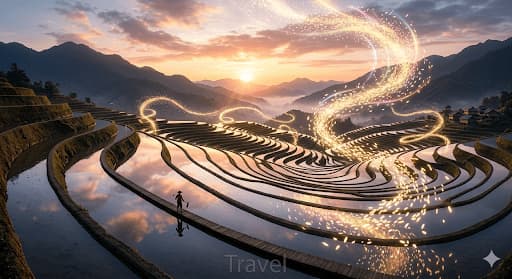
[Bottom Image Placement: A high-quality 8K image of sprawling terraced paddies reflecting the sunrise like a mirror, with tiny, glowing rice grains magically floating into the air. Bottom semi-transparent grey watermark: Travel]
This enormous irrigation system required immense manpower and high-level coordination to build and manage.
This taught humanity core values such as teamwork, precision, and long-term planning.
The paddies were also where the massive organization called the state learned to operate.
The wisdom that he who rules the water rules the world began from the paddies where I exist.
[Science of the Rice Economy explained with science]
Store of Value: Rice has low moisture content when dried and is resistant to spoilage, making it easy to store for long periods. This was the optimal property to physically store value.
Distribution of Energy: In ancient society, energy was food. Rice's complex carbohydrates provide stable, long-lasting energy, giving society members 'time' to focus on intellectual and artistic activities.
Biological Capital: Rice has an explosive ability to multiply, yielding hundreds of times the harvest from planting a single grain. This biological characteristic made possible the first capital formation, leading to the concept of compound interest.
[Grain's wisdom for modern people]
Law of Surplus: Like ancient civilizations, our 'surplus energy' investment determines our health. Filling your body with nutrient-dense, high-quality grains is the most certain health investment.
Law of Compound Interest: The stable energy of complex carbohydrates built up in your body every day acts as a powerful force like compound interest in the long run, providing tireless vitality.
