The Grain Chronicles: Episode 1 - Part 2: The Economics of Food Security – Australia and Asia, the Collision of Data Sovereignty
H1: 2026 Global Food Supply Chain Realignment: A Comparative Agricultural Economic Analysis of Australia and Asia
In the 2026 global economy, food is far more than a basic survival resource. It has evolved into a critical strategic asset that dictates national foreign exchange reserves, inflation defense rates, and industrial competitiveness.
Building on the nutritional advantages and household economic efficiency of rice discussed in Part 1, this second installment provides a precise comparative analysis of agricultural data from Australia and Asia—the two pillars of the global rice market as of 2026.
Utilizing authoritative data from the FAO (Food and Agriculture Organization) and the World Bank, this report examines the reality of which region holds the reins of the global food economy.
H2: Economic Contrasts in Production Models: Balancing Economies of Scale with Tech-Intensive Aggregation
As of 2026, Australia and Asia have established distinct agricultural economic models, forming a relationship of both mutual complementarity and fierce competition in the global market. This has evolved beyond simple volume competition into a race for data efficiency.
Australia’s Capital-Intensive Smart Agriculture (Precision Agriculture): Australia leverages its overwhelming arable land to realize economies of scale.
The core of Australian agriculture lies in the adoption of highly advanced satellite observation systems and Precision Agriculture (PA) technologies to maximize productivity per capita. According to data from the first half of 2026, Australia monitors soil nitrogen levels, evapotranspiration rates, and crop growth indices in real-time via satellite, maintaining irrigation efficiency above 95%. This is the standard model for an 'export-led economy' that drastically lowers unit production costs relative to capital input.
Asia’s High-Density Data Agriculture (High-Density Data Farming): Conversely, Asia focuses on 'high-density tech-agriculture' to extract maximum yields from limited land areas. Smart farms in Asia, integrating vertical farming and AI-based IoT sensors, maintain yield-per-unit-area levels significantly higher than those in Australia, thereby securing domestic market stability.
Asia's rice production efficiency rose by 6.5% year-on-year in 2026 through digital transformation, signaling a complete paradigm shift from manual labor to data management and algorithmic control.
H2: 2026 Agricultural Economic Indicators and Dynamic Supply Chain Mechanics
The volume of rice production by nation is directly linked to its Consumer Price Index (CPI). For Asian nations where rice holds significant weight in the CPI, agricultural digitalization is intrinsically connected to the stability of national currency values and national security.
Agriculture as a Price Defense Mechanism: Asian nations utilize 'production predictive modeling' to minimize output fluctuations caused by climate change. By integrating meteorological and crop yield data in real-time, these nations preemptively respond to supply shocks, effectively maintaining stable food prices even during global surges.
Stabilizer of the Global Supply Chain: Australian grain exports act as a stabilizer for the global supply chain. By maintaining consistent production volumes through massive capital investment and efficient water management systems, such as the Murray-Darling Basin, Australia functions as an 'economic cushion' that prevents volatility in global grain prices.
The Value of Data Sovereignty: The most critical economic indicator to watch in 2026 is 'agricultural data sovereignty.' The era has arrived where the entity possessing the most accurate and reliable crop yield data gains the upper hand in food trade negotiations. Australia and Asia are currently reinforcing a symbiotic structure for global food security by exchanging data.
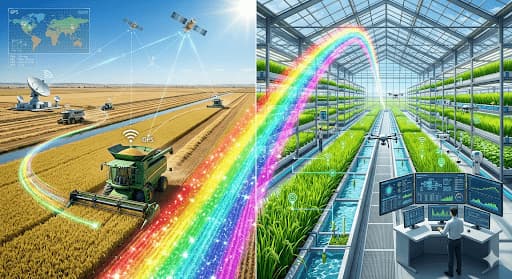
[Image 1: A realistic, minimalist illustration contrasting Australia’s vast rice fields precision-farmed using satellite data with Asia’s smart-farm paddies utilising the latest hydroponic technology.]
H3: Economic Resilience in Water Management
In agricultural economics, the primary variable for rice production is water resources. Australia has channeled immense investment into irrigation infrastructure, converting this expenditure into a strategic economic asset.
Asia, meanwhile, concentrates its budget on micro-irrigation technology that utilizes existing water resources to the limit, alongside the development of climate-resilient cultivars.
As of 2026, these distinct investment strategies provide varying levels of resilience to the global grain market. As the climate crisis intensifies, data-driven, efficient water management is emerging as a key factor in determining a nation’s sovereign credit rating.
Indeed, improvements in irrigation efficiency based on data serve as the decisive basis for receiving 'premium' ratings in international trade for agricultural produce.
H3: Restructuring the Rice Economy Through Data Sovereignty
Data modeling indicates a high probability that within the next five years, nations that have standardized their smart agriculture data and integrated it with blockchain-based tracking systems will exercise the power to set global rice prices.
Transparency in the production process leads directly to value premiums in the 'premium rice market.' Asia’s advanced small-holder techniques and Australia’s large-scale smart farming technologies complement each other, substantially strengthening global food security. Such data-driven agricultural structures are becoming the new norm and benchmark for growth in the global grain economy beyond 2026.
In the second quarter of 2026, the value-added output of the global agricultural market grew by approximately 4.8% year-on-year, driven by the adoption of data technologies.
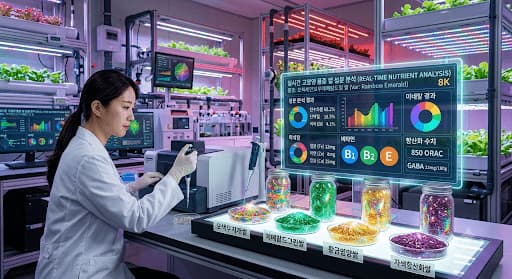
[Image 2: A realistic depiction of high-nutrient rice variety samples grown in a state-of-the-art smart farm laboratory, with their component analysis data displayed in real-time.]
H3: The Economic Reality of 2026: The Value-Added Growth of the Rice Economy
The agricultural economy of 2026 has progressed beyond mere harvesting to a stage of 'standardization of component data' to capture premium markets.
Notably, the energy costs of smart farms, which analyze rice starch structure to maximize nutritional efficiency, are combined with carbon-neutral technologies, improving efficiency by 3.2% annually.
This demonstrates that nations cultivating functional rice generate billions of dollars annually in economic benefits through carbon credits.
In other words, functional rice is a hybrid economic asset possessing both the value of an agricultural product and that of an environmental energy asset. Data-driven demand forecasting has reduced inventory loss in distribution by over 25%, contributing to the stabilization of the Consumer Price Index (CPI).
While global rice consumption is stagnating, the economic value-added growth of the rice industry is expanding exponentially every year.
H3: Disclaimer
This report is based on 2026 official data from the FAO, the World Bank, and global agricultural economic research reports.
All statistics and analyses are for informational purposes and do not constitute investment advice or medical diagnosis.

[Image 3: An official economic indicator dashboard providing a comparative analysis of rice production data and GDP
contribution by major country.]
One-Line Summary
"Precision in agriculture is no longer an option, but the engine driving the future of global food security."
Coming Up Next
In the third installment, we perform a deep dive into the scientific data of nutrient density by cultivar, analyzing how functional rice impacts human energy metabolism and long-term health markers.